You've finally decided to do something about your missing tooth.
Perhaps you've spent years avoiding certain foods, smiling with your mouth closed or feeling uncomfortable about the gap.
Dental implants seem like the answer. But then you hear something you weren't expecting:
"You might not have enough bone for an implant."
It's natural to feel disappointed or worried. Does this mean dental implants are no longer an option? Will you need major surgery? And what exactly is a bone graft?
The good news is that bone loss doesn't always mean you can't have dental implants.
For some patients, bone grafting can help create the support needed for implant treatment.
Why do you need bone for dental implants?
A dental implant it's a small titanium post placed in the jawbone to act as a replacement of the root of a missing tooth . Over time, the surrounding bone heals and bonds with the implant, helping to hold it securely in place, but for this to happen, there needs to be enough healthy bone around the implant.
Think of it like putting a fence post into the ground. Without enough solid ground around it, the post won't have the support it needs. Dental implants work in a similar way.
If your jawbone is too thin, too shallow or has lost too much volume, placing an implant without further treatment may not be advisable.
That's where bone grafting can sometimes help.
Why does your jawbone shrink after losing a tooth?
Here's something many people don't realise:
When you lose a tooth, you can also begin to lose the bone that once supported it.
Your jawbone normally responds to the forces placed on it through your teeth. When a tooth is lost, that stimulation changes and over time, the bone in that area can gradually shrink. This is known as bone resorption.
Bone loss can also happen because of gum disease, infection, injury or previous dental problems.
The longer a tooth has been missing, the more bone may have been lost, although this varies between patients.
But even if you've had a missing tooth for many years, it doesn't necessarily mean implant treatment is impossible.
What is a dental bone graft?
A dental bone graft is a procedure used to rebuild or increase the amount of bone in part of your jaw. It involves placing suitable bone grafting material into an area where additional support is needed. The material acts as a framework that encourages your body to form new bone as the area heals.
Depending on your needs, grafting material may come from your own bone, a carefully processed donor source, an animal-derived source or a synthetic alternative. Your clinician will explain which material is appropriate and discuss any concerns you may have.
The aim is to create a stronger foundation for a future dental implant.
However, not everyone who needs an implant will need a bone graft.
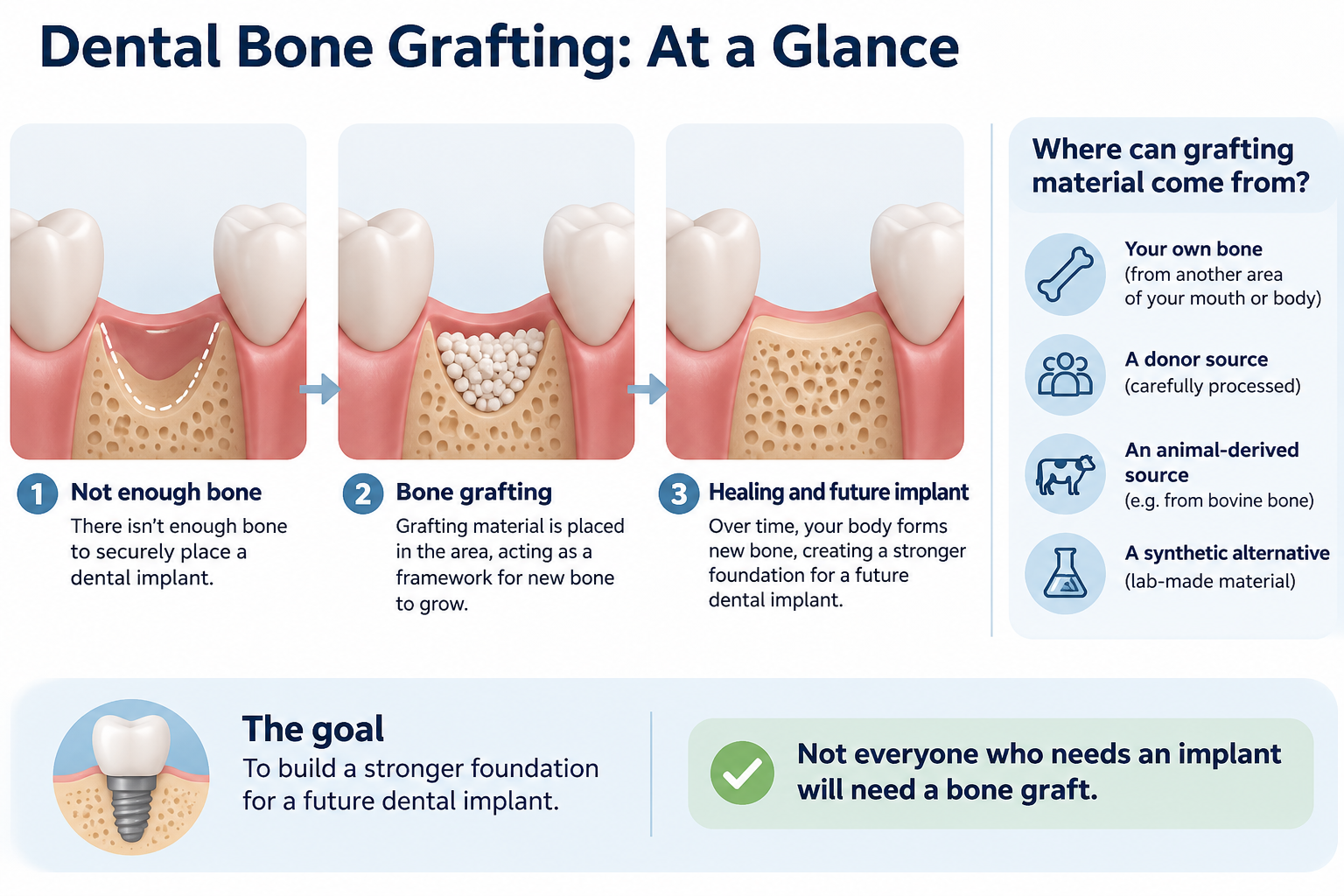
AI Illustration showing three stages of dental bone grafting: reduced jawbone, placement of bone grafting material, and new bone formation during healing.
How do we know if you need bone grafting?
You can't tell how much jawbone you have simply by looking in the mirror, that's why careful assessment is so important.
At The Lytham Dental Clinic, your journey begins with a consultation to discuss your dental health, missing teeth and treatment options. Following your initial assessment, you'll be offered a complimentary consultation with our implantologist, Dr Pavan Padaki, who also works as an Oral and Maxillofacial Surgeon. He'll assess whether bone grafting is necessary and whether further imaging, such as a CBCT scan, is needed.
A CBCT scan produces detailed 3D images of your jaw. These help us assess the available bone and plan implant placement. Sometimes there's enough bone already, sometimes a small graft may be helpful, and in other cases, more extensive treatment may be required.
The important thing is that we only recommend bone grafting when there's a clinical reason for it.
Does dental bone grafting hurt?
For many patients, this is their biggest concern.
The thought of having bone added to your jaw can sound more intimidating than the procedure itself.
Bone grafting is usually carried out under local anaesthetic, which numbs the treatment area.
You may feel pressure or movement, but you shouldn't feel sharp pain during the procedure. If you do feel discomfort, you should tell your clinician.
Afterwards, some swelling, tenderness or bruising is common.
The amount of discomfort depends on the size and location of the graft, as well as how your body heals.
We'll explain what to expect and provide advice on caring for the area afterwards.
How long does a bone graft take to heal?
Bone needs time to heal and develop around the grafting material.
For some patients, a small bone graft can be placed at the same time as their dental implant.
For others, the graft needs to heal before implant placement can begin.
Healing can take several months, depending on the type of graft, the amount of bone required and your individual circumstances.
This may make your overall implant treatment longer.
Although waiting can feel frustrating, allowing adequate healing time is important for giving the implant a suitable foundation.
How much does bone grafting cost at Lytham Dental Clinic?
We know that unexpected dental costs can be worrying, especially when you're planning a significant treatment such as dental implants.
That's why we take a different approach to explaining our prices.
At The Lytham Dental Clinic, our advertised implant prices account for the possibility that you may need bone grafting or a CBCT scan.
We include these potential procedures when discussing costs so patients aren't surprised by them later.
But if you don't need a bone graft or CBCT scan, you won't be charged for that procedure.
Your individual treatment plan will explain which procedures you require and what you'll pay.
We also offer finance options for eligible patients who would prefer to spread the cost of treatment.
Can you still have dental implants if you've lost a lot of bone?
Possibly.
Significant bone loss can make implant treatment more complex, but it doesn't automatically rule it out.
Some patients may benefit from bone grafting. Others may need a different implant approach or may be better suited to alternatives such as bridges or dentures.
There are also situations where bone grafting isn't appropriate or cannot provide the support required.
The only reliable way to understand your options is through a clinical assessment.
Don't let bone loss stop you from asking
If you've been missing a tooth for years, or someone has previously told you that you don't have enough bone for implants, you may have assumed there's nothing more you can do.
But your options may be worth exploring.
At The Lytham Dental Clinic, we help patients from Lytham St Annes, Blackpool, Preston and across the Fylde Coast understand their options for replacing missing teeth.
We'll assess your oral health, explain whether bone grafting could help and discuss the benefits, risks, costs and alternatives.
And if bone grafting isn't necessary, we won't recommend it.
Because the goal isn't to provide more treatment. It's to provide the right treatment for you.
Explore dental implants at The Lytham Dental Clinic or call us on 01253 736633 to arrange a consultation.