Multiple Dental Implants: Options for Replacing Several Missing Teeth
Missing several teeth can affect more than the appearance of your smile. Depending on where the gaps are, you may notice changes when eating, speaking or simply feeling comfortable around other people.
If you're considering dental implants, one of your first questions may be:
Do I need a dental implant for every missing tooth?
Not necessarily.
When several teeth are missing, dental implants can be used in different ways. Some teeth may be replaced individually, while in other situations a smaller number of implants can support several replacement teeth as an implant-supported bridge.
The right approach depends on your mouth, the position of the missing teeth and your individual needs.
What are multiple dental implants?
A dental implant replaces the root of a missing tooth.
The implant itself is a small titanium piece that sits within the jaw, and can be used to replace a single tooth or support restorations replacing several teeth.
Click her to view more about single implants
If you’re missing more than one tooth, this doesn’t automatically mean placing one implant for every tooth.
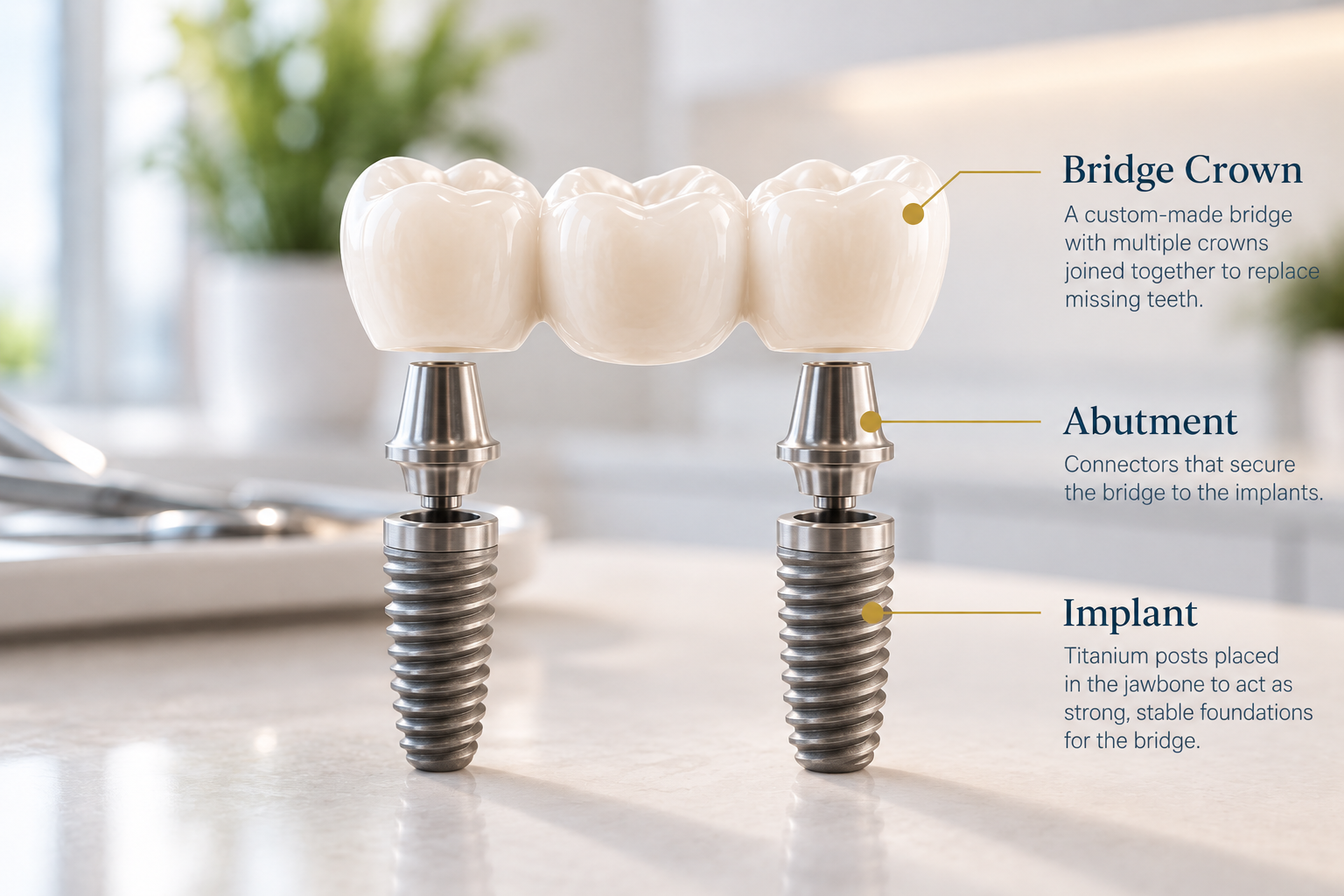
For example, if you have several missing teeth next to each other, implants may sometimes be positioned at either end of the gap to support a bridge of replacement teeth. Think of it as a bridge supported by strong foundations.
The implants provide the support, while the dental bridge replaces the visible missing teeth.
In other situations, separate implants may be more appropriate.
Your implant assessment allows us to look at the gap, surrounding teeth, gums and available bone before recommending an approach
Do I need an implant for every missing tooth?
This is one of the most common misconceptions about multiple dental implants.
Imagine you have three missing teeth together. You might assume:
3 missing teeth = 3 dental implants.
But that isn't always necessary.
In suitable cases, two implants may be able to support a three-tooth implant bridge.
This can avoid placing an implant beneath every replacement tooth while still providing a restoration that remains securely in the mouth.
However, every situation is different. The number and position of implants required depends on factors including the number and location of missing teeth, your bite, available bone and the forces the restoration will need to withstand.
The aim isn't simply to use the fewest or greatest number of implants. It's to create an appropriate treatment plan for your individual circumstances.
What is an implant-supported bridge?
A traditional dental bridge usually gains its support from natural teeth next to the gap.
An implant-supported bridge gains its support from dental implants instead.
The implants are placed into the jawbone and, after the appropriate healing period, are used to support the replacement teeth.
This can be particularly useful when several neighbouring teeth are missing.
Because the restoration is supported by implants, it can also avoid preparing healthy neighbouring teeth solely to support a conventional bridge.
Multiple dental implants vs a removable denture
Dental implants aren't the only way to replace several missing teeth.
A removable partial denture may also replace multiple teeth and can be a suitable option for many patients.
The major difference is how the replacement teeth are supported and whether you remove them yourself.
A partial denture is designed to be taken in and out for cleaning. An implant-supported bridge remains in the mouth and is cared for with daily cleaning around and underneath the restoration.
Neither option is automatically right for everyone.
Some patients prioritise having teeth that remain securely in place. Others may prefer a removable option because of their oral health, anatomy, treatment preferences or budget.
Understanding those differences is an important part of deciding what is right for you.
What happens when you have multiple dental implants?
Treatment starts with a detailed assessment.
We will examine your teeth and gums, discuss your medical and dental history and assess the areas where teeth are missing.
X-rays and, where appropriate, a 3D scan may be used to assess the available bone and help plan implant positions.
If implant treatment is suitable, the process generally includes several stages.
1. Planning your replacement teeth
Before placing implants, we need to consider the final result.
How many teeth need replacing? Where should the implants sit? How will your new teeth meet the opposing teeth when you bite?
Careful planning helps determine the number and position of implants required.
2. Placing the implants
The planned implants are placed into the jaw under local anaesthetic.
The area is therefore numb during the procedure.
3. Healing
The implants usually need time to integrate with the surrounding bone before supporting the final teeth.
This process can take several months, although treatment times vary between patients.
4. Creating your implant-supported teeth
Once the implants are ready to restore, impressions or digital scans can be taken to help create your replacement teeth.
The final restoration is then fitted to the implants and your bite can be checked.
Does having multiple implants hurt?
Implant placement is normally carried out using local anaesthetic, so the treatment area is numb during the procedure.
Afterwards, it is normal to experience some discomfort, swelling or bruising while the area heals. The amount varies from person to person and can also depend on the extent of treatment.
Your dental team will explain what you can expect following treatment and how to look after the area.
If you're nervous about dental treatment, please tell us. Understanding what worries you allows us to explain each stage and help make your appointments feel more manageable.
What if I've lost bone around the missing teeth?
Bone can gradually reduce after a tooth is lost.
That doesn't necessarily mean you can't have dental implants.
Some people have enough healthy bone to place implants without additional treatment. Others may require bone grafting to create sufficient support for an implant.
This is one reason why an implant assessment and appropriate imaging are important.
If bone grafting is recommended, your clinician will explain why it may be needed, what the procedure involves and how it could affect your overall treatment time.
Been told you don't have enough bone for implants? Read our guide to bone grafting for dental implants.
How much do multiple dental implants cost?
At The Lytham Dental Clinic, a single dental implant restored with a crown currently starts from £3,645.
Your individual cost can vary depending on the complexity of treatment and whether additional procedures are required.
The total cost depends on factors such as:
how many teeth need replacing
how many implants are required
whether the implants support individual crowns or a bridge
the complexity of treatment
whether bone grafting or other additional treatment is required
This is also why multiplying the price of one implant by the number of missing teeth may give you a misleading estimate.
If three teeth are missing, for example, it doesn't necessarily mean you will require three separate implants and three individual crowns.
Following your implant assessment, we can explain which options are clinically suitable and provide a personalised treatment plan with the expected costs before you decide whether to proceed.
How long do multiple dental implants last?
Dental implants are intended to provide a long-term solution for missing teeth, but no dentist can promise that an implant will last forever, dentists usually say 10-15 years.
Long-term outcomes can be influenced by several factors, including your gum health, oral hygiene, smoking, general health, bite and how well the implants are maintained. And the other way around, if treated with proper care, with regular hygienes and checkups and a good oral health they can last 20+ years.
The replacement teeth themselves can also require maintenance, repair or replacement over time.
Having implants therefore doesn't mean you can forget about the area.
Daily cleaning, regular dental examinations and professional maintenance remain important for protecting the health of the gums and tissues surrounding your implants.
What if I'm missing most or all of my teeth?
Replacing two or three missing teeth is different from rebuilding an entire arch of teeth.
If you have many failing or missing teeth, another type of implant treatment may be more appropriate than several individual implants.
For example, a full arch of replacement teeth can sometimes be supported by a strategically planned number of implants.
You may have heard terms such as All-on-4 or All-on-6 used to describe this type of treatment.
The number of implants required is not the same for every patient, so a full assessment is needed before deciding on the most appropriate approach.
Missing most or all of your teeth? Coming soon, guides to full-arch dental implants, including All-on-4 and All-on-6.
Could multiple dental implants be right for you?
If you're missing several teeth, you don't need to work out how many implants you need before speaking to a dentist.
That's part of the planning process.
At The Lytham Dental Clinic, we can assess your missing teeth, remaining teeth, gums and available bone before talking you through the options that may be suitable.
That might involve individual implants, an implant-supported bridge, a removable solution or another form of treatment.
The important thing is understanding your choices.
Missing several teeth and considering dental implants in Lytham St Annes, Blackpool or the Fylde Coast? Contact our team to arrange an implant consultation and explore your options.
Dental implant treatment is subject to clinical assessment and is not suitable for everyone. Treatment requirements, timescales, costs, risks and outcomes vary between patients. Your clinician will discuss the benefits, risks, alternatives and ongoing maintenance requirements with you before treatment.