Single Dental Implant: Cost, Procedure & What to Expect
Losing one tooth can seem like a small problem, especially if the gap is towards the back of your mouth. But when it affects how you eat, smile or feel about your teeth, you may start wondering whether you should replace it.
A single dental implant is one option for replacing one missing tooth. Unlike a conventional dental bridge, it can replace the missing tooth without relying on neighbouring teeth for support.
But what does having an implant actually involve? Does it hurt? How long does treatment take, and how much does a single dental implant cost?
Here’s what you need to know.
What is a single dental implant?
A dental implant replaces the root of a missing tooth.
A small titanium implant is placed into the jawbone. Once it has healed and integrated with the surrounding bone, it can support a dental crown — the part that looks like your tooth.
The finished restoration therefore has three main components:
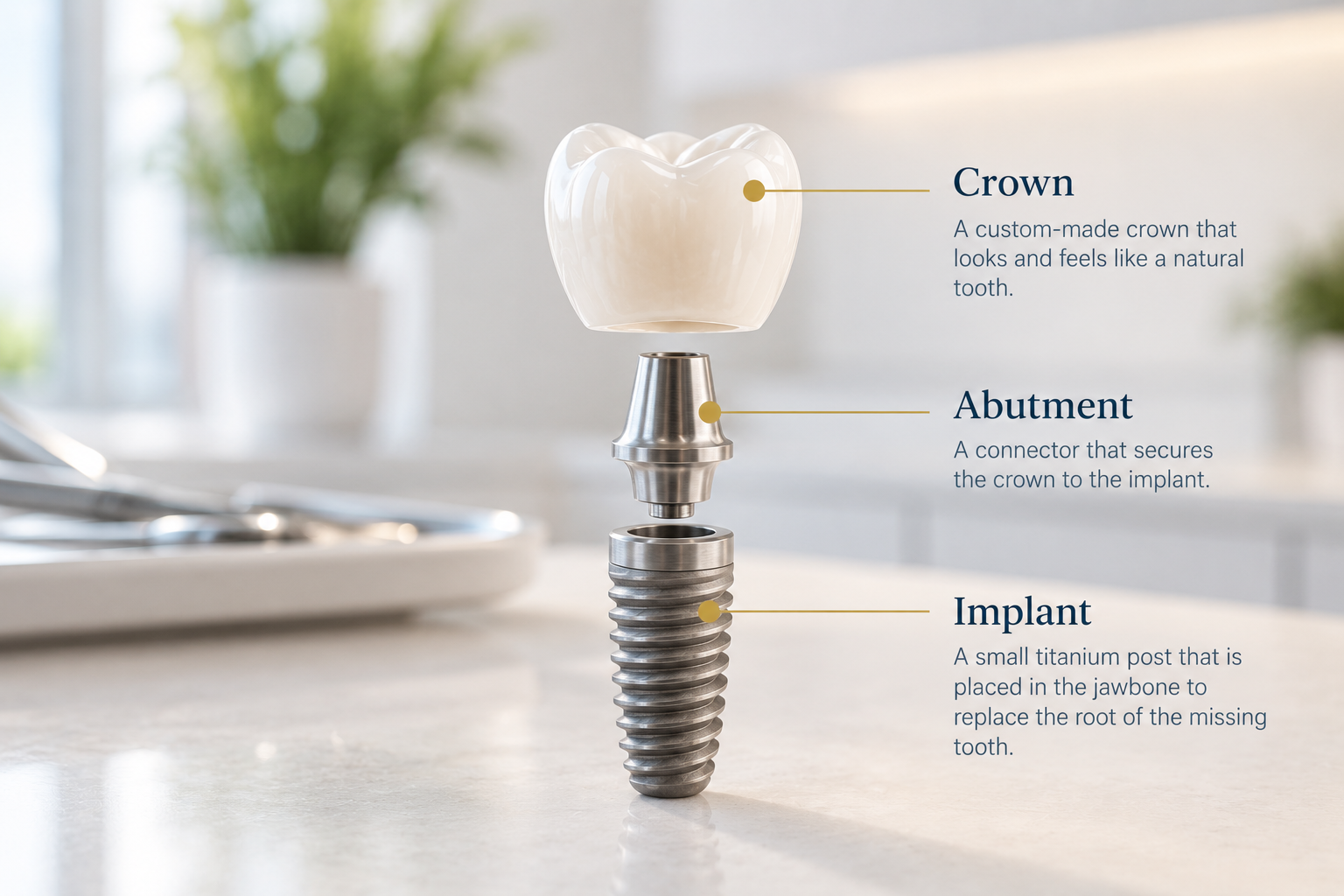
Implant → Abutment → Crown
The implant sits within the jaw, the abutment connects the two parts, and the crown is the part you see when you smile.
Dental implants can be used to replace a single tooth or support restorations replacing several teeth.
Why replace one missing tooth with an implant?
One of the main advantages of a single dental implant is that it does not normally require the neighbouring teeth to support the replacement tooth.
With a conventional dental bridge, one or more neighbouring teeth may need to be prepared so they can support the bridge. An implant is supported independently by the jawbone.
For suitable patients, a single implant may help to:
restore the appearance of a missing tooth
improve chewing in the area
provide a replacement that stays in the mouth
avoid preparing healthy neighbouring teeth for a conventional bridge
support the bone in the area of the missing tooth
However, implants are not automatically the best choice for everyone. A bridge, removable denture or, in some situations, leaving the space may also be considered.
What happens when you have a single dental implant?
Your treatment starts with an implant assessment.
We need to understand why the tooth was lost, check the health of your remaining teeth and gums, and assess the amount of bone available.
X-rays and, where appropriate, a 3D scan can help us assess the area and plan the position of the implant.
If an implant is suitable, treatment usually involves several stages.
1. Placing the implant
The implant is carefully positioned within the jawbone. This is usually carried out using local anaesthetic so the area is numb during treatment.
2. Allowing it to heal
The implant then needs time to integrate with the surrounding bone.
This is an important part of the process and means a dental implant is not normally an instant replacement tooth. Healing times vary, but implants are commonly allowed several months to integrate before the final restoration is fitted
.
3. Creating your new tooth
Once the implant is ready to restore, measurements or digital scans can be taken to create your crown.
The crown is designed to work with your bite and complement the surrounding teeth.
Whatever it is, the way you tell your story online can make all the difference.
Does having a dental implant hurt?
This is understandably one of the biggest concerns for many patients.
The implant placement itself is usually performed under local anaesthetic, which numbs the treatment area.
Afterwards, some soreness, swelling or bruising can occur while the area heals. The amount varies between patients, and your dental team will explain what to expect and how to look after the area following treatment.
If you're nervous about dental treatment, tell us. We can take time to explain each stage and discuss ways of making your appointments feel more manageable.
What if I don't have enough bone?
Having reduced bone does not necessarily mean that an implant is impossible.
Some patients have enough bone for an implant without additional treatment. Others may require bone grafting to increase the amount of bone available to support an implant.
This is assessed individually.
If a graft is recommended, we will explain why, what it involves and how it may affect your treatment time before you decide whether to proceed.
Been told you don't have enough bone? Read our guide to bone grafting for dental implants.
Single dental implant vs dental bridge: what's the difference?
Both can be used to replace a missing tooth, but they work differently.
A dental implant is supported by an implant placed within the jawbone.
A dental bridge uses neighbouring teeth to support a replacement tooth. Depending on the type of bridge, this may involve preparing one or more of those teeth.
That doesn't mean an implant is always better than a bridge.
The condition of your neighbouring teeth, your gums, available bone, bite, general health, preferences and budget can all influence which option is most appropriate.
How much does a single dental implant cost?
At The Lytham Dental Clinic, a single dental implant restored with a crown currently starts from £3,645.
Your individual cost can vary depending on the complexity of treatment and whether additional procedures are required.
For example, some patients may need bone grafting.
Following your assessment, we can explain the options suitable for you and provide a treatment plan with the expected costs before treatment begins.
How long does a single dental implant last?
Dental implants are designed as a long-term way of replacing missing teeth, but no dental treatment can be guaranteed to last for life.
Published NHS patient information reports high long-term implant survival rates, but outcomes vary between individuals. Factors including gum health, smoking, oral hygiene, the amount and quality of bone, general health and ongoing maintenance can influence long-term success.
Your implant and the teeth around it therefore still need regular care.
That means good cleaning at home, dental examinations and professional maintenance as recommended by your dental team.
Am I suitable for a single dental implant?
Many adults with a missing tooth may be able to consider implant treatment, but suitability needs to be assessed properly.
We will look at factors such as:
the health of your teeth and gums
the amount of available bone
your medical history
smoking
your bite
how well you can keep the area clean
what you would like from treatment
Sometimes another option may be more suitable. The purpose of your consultation is to understand those choices rather than assume that an implant is automatically the answer.
Missing one tooth? Find out what your options are
If you have lost a tooth — or have been told that a tooth may need to be removed — you don't have to decide on the replacement immediately.
At The Lytham Dental Clinic, we can assess the area and talk you through the options that may be suitable, including a single dental implant, bridge or other forms of tooth replacement.
Our implant consultations currently cost £89, and we also offer a complimentary initial conversation with our Treatment Coordinator if you would like to find out more before booking a clinical consultation.
Considering a dental implant in Lytham St Annes, Blackpool or the Fylde Coast? Contact our team to start the conversation.
Dental implant treatment is subject to clinical assessment and is not suitable for everyone. Treatment requirements, timescales, costs, risks and outcomes vary between patients. Your clinician will discuss the benefits, risks, alternatives and ongoing maintenance requirements with you before treatment.